Wang Zhen violated the "ban"
This year marks the 110th anniversary of Wang Zhen’s birth. Through some details, we can better understand the revolutionary.
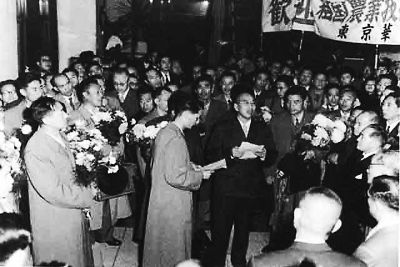
In the autumn of 1957, Wang Zhen, Minister of State Land Reclamation, was appointed to lead a delegation of China non-governmental agriculture to visit Japan. Before the trip, Mao Zedong, Zhou Enlai and Wang Zhen decided the purpose of this visit: to promote the friendship between the Chinese and Japanese peoples, focus on the successful experience of Japan’s post-war agricultural development, and promote the agricultural development in China. At that time, China and Japan had not yet established diplomatic relations, and Wang Zhen was a fierce anti-Japanese. Someone asked Wang Zhen, "Are you afraid of going to Japan?" Mao Zedong answered for him: "He has nothing to fear!"
The delegation includes 30 experts and scholars in agriculture, forestry, animal husbandry and agricultural machinery. Wang Zhen led a delegation to visit Japan for two months, most of which were in the countryside and often traveled in the countryside. He cherished this rare opportunity very much, did not forget his mission, and carefully inspected the agricultural conditions along the way.
One day, the delegation’s vehicle was traveling on a country road. In the newly harvested rice fields on the roadside, a small agricultural machinery was busy, which attracted Wang Zhen’s attention. He quickly signaled to stop, and then strode towards the small agricultural machinery, observing it carefully: two small rubber wheels were carrying a small engine, and the engine was equipped with a long armrest that served as a steering wheel. Under the armrest was the driver’s seat. The owner of the machine told Wang Zhen through an interpreter that the machine was called a walking tractor. Wang Zhen repeatedly asked about the functions and uses of walking tractors, and sat in the driver’s seat with great interest. Back in the car, he excitedly said to the members of the delegation: "This walking tractor is suitable for paddy fields in southern China."
Before returning to China, Wang Zhen wanted to buy a walking tractor prototype produced by Kubota and bring it back to China. He was reminded that it would violate the ban of the Prime Minister. It turns out that there is a special ban in Zhou Enlai’s pre-departure request: Japanese people want to do business with us very much, and don’t buy their things when they arrive in Japan. Wang Zhen said: Although the Prime Minister told us not to buy their things, they are really good and useful for our agricultural development! So he decided to buy it.
After returning to China, Zhou Enlai met Wang Zhen and joked: "I knew that your beard couldn’t control himself, so I had to explain it before I went. I didn’t expect you to violate the ban." Seeing that Wang Zhen was embarrassed, he laughed. "These things you bought are very good!" Later, Zhou Enlai also specially instructed to import some walking tractors from Japan and distribute them to various provinces.
When Wang Zhen reported the successful experience of Japanese agricultural technology to Mao Zedong, he also introduced the use of walking tractors. Mao Zedong said with deep feeling that the Japanese nation is a great nation, which not only maintains its own national characteristics, but also accepts foreign new technologies with great sensitivity. At this point, we should learn from the Japanese nation.
In his report to the Central Committee on his visit to Japan, Wang Zhen put forward specific suggestions on accepting foreign new technology and developing, popularizing and popularizing walking tractors.
Walking tractors were soon born in China, and mass production was formed. Because of its low cost, small size, flexibility and strong power, it can plow, rotate, sow, harvest, irrigate and thresh, and run for transportation. It is very popular with farmers and is called "all-rounder". In the 1960s, walking tractors became popular rapidly, which became an important means and symbol for farmers to get rich in China. They were widely used not only in southern China, but also in rural areas in northern China, and became the pioneer of agricultural mechanization in China.
Wang Zhen is the main promoter of the popularization of walking tractors, but in the process of popularization, he insists on seeking truth from facts and resolutely opposes the unrealistic "Great Leap Forward". During the "Cultural Revolution", there was a tractor battle in some places, which was denounced by Wang Zhen as "a crooked mouth and a monk chanting scriptures blindly".
At that time, Wang Zhen was sent to Jiangxi Red Star Reclamation Field. At that time, Jiangxi Province gave the Agricultural Machinery Factory of Hongxing Reclamation Farm the task of producing 500 walking tractors. Red Star Agricultural Machinery Factory has been working hard for a long time without success, so it has to dismantle a walking tractor and piece together a "new tractor" to report good news to the county seat. Unexpectedly, the fire went out just after driving to the factory gate.
Wang Zhen knew that Hongxing Agricultural Machinery did not have this kind of production capacity at all, and said angrily: "This is a blind command that wastes people and money!" It is suggested that the agricultural machinery factory should focus on the production of harvesters and shredders that are urgently needed, and don’t engage in tractors any more.
When Wang Zhen saw that everyone had concerns, he said frankly: "If the above is held accountable, I will punish you." A few days later, the tractor war headquarters sent a working group down and saw that the agricultural machinery factory stopped the tractor manufacturing. Those people shouted angrily: "We are going to sue you!" " At the critical moment, Wang Zhen stood up and said righteously: "We don’t have the conditions to produce tractors here. We don’t want to engage in this kind of’ ghost pulling machine’, but we want to engage in shredders." The old general clanked with iron, and the people in the headquarters were frightened, and they slipped away the next day.
(Author: Hubei Ezhou Municipal Committee Office)