"QR code" or "blocking code"? Perspective on the phenomenon of "compulsory attention" in code scanning consumption
Xinhua News Agency, Shanghai, March 18th Question: "QR code" or "blocking code"? Perspective on the phenomenon of "compulsory attention" in code scanning consumption
Xinhua News Agency reporters Wang Moling and Cheng Siqi
Parking payment, ordering and shopping … … Nowadays, scanning code payment instead of manual service has become a daily life. However, this kind of consumption mode, which should be "efficient" and "convenient and fast", has brought troubles to many consumers because some places pay attention to WeChat official account, are forced to authorize personal information, and frequently push advertisements every day. Based on the convenient "two-dimensional code", it becomes a "blocking code", which is worthy of attention.
Scan code consumption brings inconvenience and worry.
In February this year, Mr. Zhao, a citizen of Shanghai, and his family went to Changshu City, Jiangsu Province to play. After dinner in a local shopping mall, he drove out of the underground garage. The mall prompted to scan the code to pay. Mr. Zhao scanned it and found that he had to pay attention to the WeChat account of the mall first, and then click on the parking payment menu to jump to the applet to complete the payment.
"Pay a parking fee and pay attention to the mall in WeChat official account, which is unreasonable to me. What is even more disappointing is that there is a new energy car driver at the front, because the new energy license plate number is one more than the fuel car. He lost several times in the small program and got stuck there without success, resulting in several cars blocked behind. It was not until the staff arrived that the problem was solved. " Mr. Zhao said.
The reporter found that this is a common phenomenon, and many shopping malls have their own payment rules. Some people have to scan the code to pay attention to WeChat official account in the shopping mall, and register members to get points to deduct parking fees. Some people have to pay attention to a third-party WeChat official account first, and they have to authorize "get your mobile phone number" to complete the payment process. Both WeChat official account, a shopping mall, and WeChat official account, a third party providing payment services, will push various advertisements from time to time.
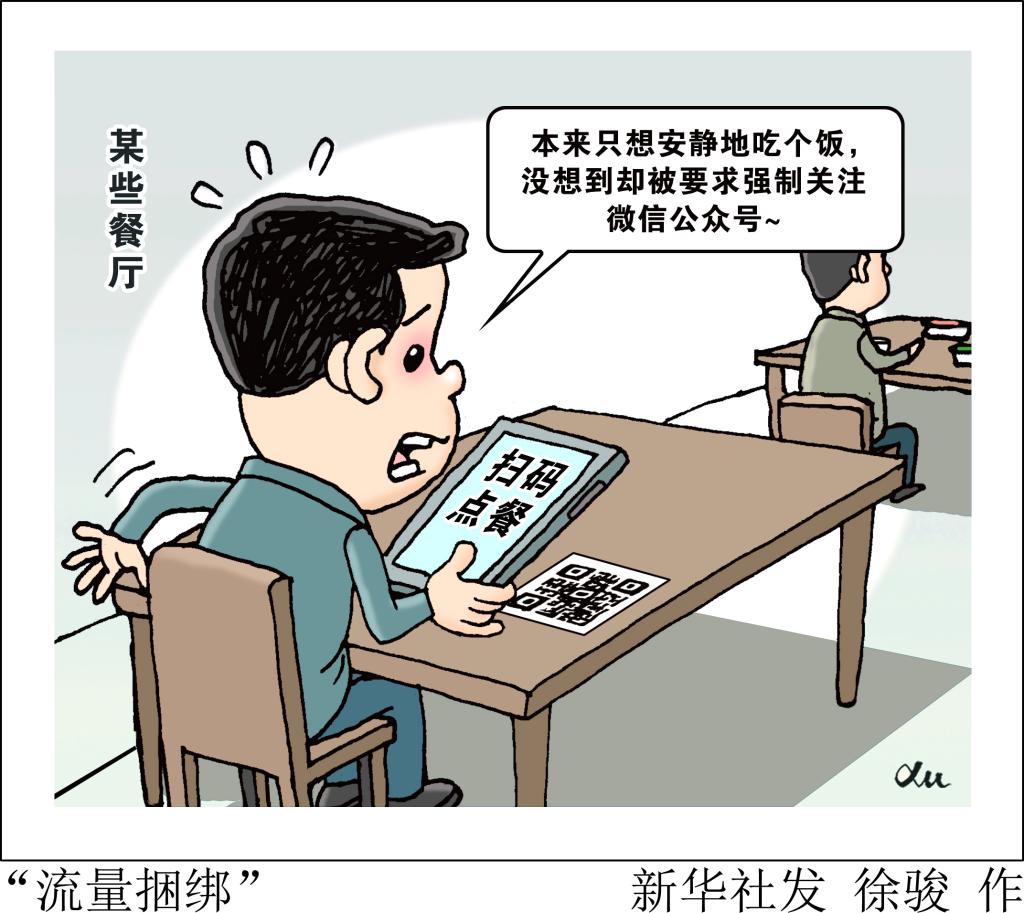
In the interview, the reporter learned that in the scenes of ordering food, buying milk tea, waiting in line, and shopping discounts in restaurants similar to parking, consumers are almost always guided to scan the QR code. After scanning the code, the page will jump directly to the "registered member" or "WeChat quick login" page. Consumers must agree to the authorization of personal information before ordering or receiving coupons.
"Every time you scan the code, the merchant’s Member Agreement and Privacy Terms will pop up. If you don’t agree, you can’t proceed to the next step. You are forced to agree, and you are worried that personal information and privacy may be leaked." Consumer Ms. Zou said, "Unconsciously, I found myself paying attention to a bunch of WeChat official account, and I was always pushed all kinds of junk advertisements, which was annoying."
Force "scan code to pay attention" to risks and infringement.
The seemingly "routine" practice of "scanning code and paying attention to WeChat official account" is likely to have the risk of information leakage and is suspected of infringement.
— — "Voluntary in form, compulsory in essence" trading behavior, or infringement of consumers’ fair trading rights. Xu Wenhai, director of the Research Center for Diversified Dispute Resolution and Rule of Law of Tongji University Law School, said that this kind of consumer service mode of compulsory code scanning infringes on consumers’ fair trading rights to a certain extent. "The Law on the Protection of Consumer Rights and Interests in People’s Republic of China (PRC) clearly stipulates that operators are not allowed to use format terms and use technical means to force transactions, and compulsory code scanning is unfair to some consumers who are unwilling to scan codes."
— — "Can’t refuse to be marketed" is a disrespect for consumers’ right to choose independently. Many consumers have reported that "it is obviously parking fees and paying for meals, but it will be frequently pushed with various marketing information". Guo Weihong, deputy director of the Pacific Century Network Compliance Center, said that the Measures for the Supervision and Administration of Online Transactions stipulates that online transaction operators may not send commercial information to consumers without their consent or request. "Many businesses have not given it to consumers ‘ Refuse to be marketed ’ The option, even if the consumer agrees, is formed involuntarily, which is a disrespect for the consumer’s right to choose independently. "
— — Excessive demand for information increases the risk of consumer information disclosure. "When consumers pay by scanning code, merchants often ask consumers to pay attention to their WeChat official account, fill in their personal information and enjoy discounts as members, or automatically obtain their personal information such as phone number, birthday, gender and geographical location associated with WeChat and Alipay through WeChat official account or small programs. However, it is obvious that this information is not necessarily related to in-store consumption, which may involve excessive collection of consumer information. " Cheng Zhiguo, a lawyer of Beijing Jingda (Shanghai) Law Firm, said that once the merchants do not keep the data properly, consumers will also bear the risk of personal information leakage and loss. "The code scanning consumption model should not become a tool to obtain users’ personal information."
"code scanning consumption" should not become "multiple choice questions"
In view of the chaotic phenomenon of "compulsory attention" in code scanning consumption, in recent years, many consumer rights protection associations have issued self-discipline commitments and initiatives on code scanning consumption industry, calling on businesses such as shopping malls, restaurants and parking lots not to force consumers to pay attention to their WeChat official account and not to ask for consumers’ personal information excessively during code scanning payment. On the WeChat platform, the option of "compulsory attention to behavior" has also been added to WeChat official account’s complaint page.
Relevant supervision has also continued to keep up. The newly revised "Regulations on the Management of Internet Users’ Public Account Information Services" by the National Internet Information Office clearly stated that without the informed consent of Internet users, it is not allowed to forcibly subscribe to other users’ public accounts in any way or in disguised form. The China Consumers Association issued a document clearly stating that the act of forcibly scanning the code to order food, paying attention to WeChat official account or authorizing personal information violates the Consumer Protection Law. Consumer protection departments in Shanghai and other places continue to increase spot checks and unannounced visits to related enterprises.
Experts interviewed and relevant departments said that "code scanning attention" should not be a "multiple choice question" in the consumption scene, and consumers, businesses and regulatory authorities all need to make a difference.
Consumers should raise their awareness of protecting personal information security. The Shanghai Consumer Protection Committee suggested that consumers should pay attention to the protection of personal information. If personal information is excessively collected or improperly used, they can call 12345 to report to the online information and market supervision departments, or complain or reflect to the consumer protection department.
Merchants should consciously provide online code scanning, offline labor and other ways. "Merchants should actively cooperate to provide services such as physical menus and manual bills." Xu Wenhai said that when consumers spend by scanning code, they are advised to collect only the minimum necessary information, and after consumption, they should take the responsibility of clearing the corresponding consumption information of customers, and consciously avoid the occurrence of data leakage and data abuse for profit.

In 2021, the Consumer Council of Shenzhen, together with relevant units, launched the Self-discipline Commitment of Code Scanning Consumer Industry.
Chen Yinjiang, deputy secretary-general of china law society Consumer Protection Law Research Association, suggested that the relevant regulatory authorities could establish a joint law enforcement and supervision mechanism, strictly implement the identification standards for the use of two-dimensional codes, and reduce or prohibit some businesses from forcibly collecting user information. In view of some businesses and platforms that violate consumers’ wishes and even abuse personal data, a long-term mechanism should be established to punish violations of consumers’ rights and interests and protect consumers’ legitimate rights and interests.