Hebei Xinle "milk water" watered wheat and "green tea water" watered trees, and relevant local departments have been involved in the investigation.
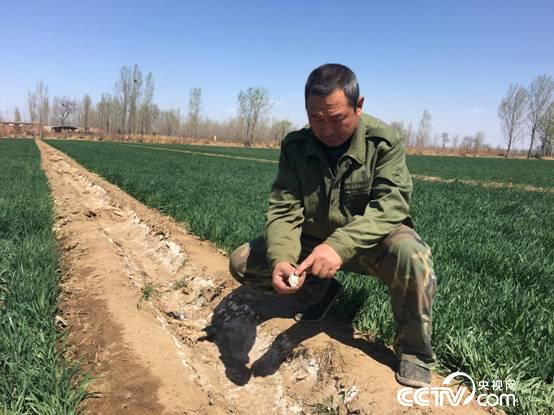
White crystals formed after "milk water" is poured with wheat (photo/Xu Hui)
Cctv news(Reporter Xu Hui) For farmers in the north, spring is the season when wheat is in urgent need of irrigation. However, there are more than 40 mu of wheat in Minzhen Village, Xinle City, Shijiazhuang City, Hebei Province, and it is too late to irrigate, because the milky "milk water" flows out of the well.
The villagers reported that the well in Minzhen Village began to drip "milk water" during irrigation last spring. However, a well hundreds of meters away from the well pumped up green water.
As early as three years ago, the drinking water in the village’s "cattle-raising community" found problems. "After boiling, there was a layer of white powder floating on it." To this end, nearly 60 households began to "beg" for water to eat nearly a kilometer away.
On the night of March 30th, the official WeChat of Shijiazhuang Ecological Environment Bureau, WeChat official account, reported that a special working group had been set up to carry out work at the site.

On March 20, the villagers in Minzhen Village watered the "milk water" flowing out of the well.
Many irrigation wells in the north of the village are now "problem water"
Minzhen Village, Xieshen Township, Xinle City is a small village at the junction of Xinle City, Zhengding County, Xingtang County and Lingshou County, with a population of about 2,600.
At 8 o’clock on March 20, Tang Aizhong, a villager in Minzhen Village, began to irrigate more than 2 mu of wheat, and he became the first user of this well after "sleeping" for a winter.
"The water pumped up is milky white, and it has been poured for more than 3 hours on 2 acres. The water has always been like this." Tang Aizhong said.
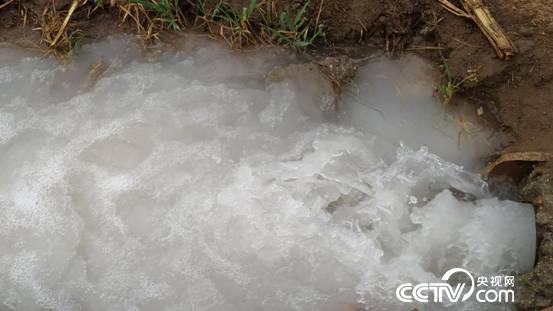
On March 20 th, a close-up of "milk water" was poured on wheat in Minzhen Village, Xinle City.
On March 30th, the reporter went to Tang Aizhong’s wheat field in the north of Min Town. The furrows are covered with a layer of white crystals, which are gently twisted into fine powder by hand. The root of wheat is a layer of white, covering the original light green of wheat.
"This well was like this when it was watered with wheat last year, and all the white water was pumped out." Tang Aizhong’s neighbor Tang Laowu said.
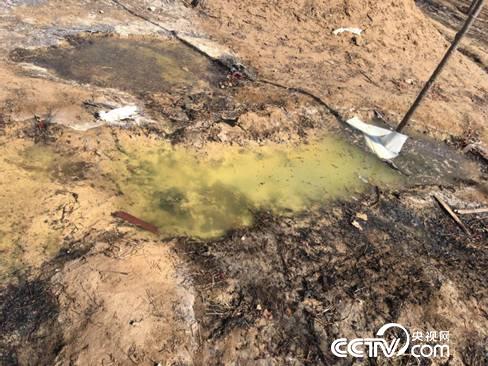
About 300 meters north of the "milk water" well, the water in a well is light green. (Photo/Xu Hui)
The well with problems is not the only one in the village. About 300 meters north of the well, and closer to Xingtang County, there was a well drilled in the cemetery, and green water flowed out.
According to a video taken last summer provided by villagers, a villager and two children were standing in the water with muddy well water flowing out of the water pipe. The man is holding a bottle filled with green water, and the water in the low-lying area of the woodland is also green.
On March 30, when the well was pumped again, the well water was slightly clear, but the water in the low-lying areas was still light green.
Mr. Sun, a villager in Minzhen Village, contracted more than 100 mu of land to plant saplings. The well flowing out of green water is in Mr. Sun’s contracted land.
"Last year’s water was green, and the water you will see has been reduced a lot because of repeated pumping in the past few days." The villagers introduced.
Tang Yanqun, secretary of Minzhen Village Branch, told the reporter that after finding that there was a problem with the water from the well, the well had been specially assigned to take care of it, and villagers were not allowed to continue to irrigate wheat. "The irrigation area of this well is more than 40 mu. After the water quality test results come out, it is necessary to determine whether this well can be used."
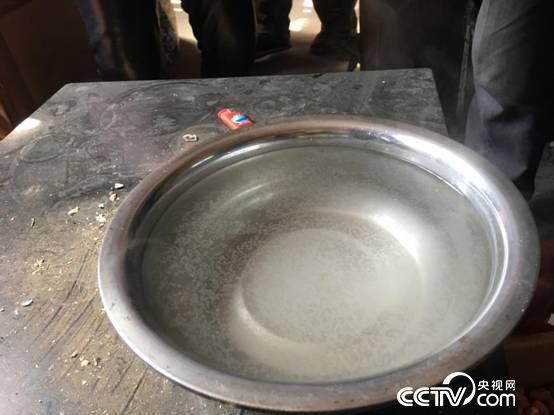
After the drinking water in the cattle-raising community was boiled, a layer of white substance floated on it. (Photo/Xu Hui)
In the past three years, nearly 60 households have entered the village to "beg" for water.
There is a "cattle-raising community" in the north of Minzhen village, which was planned and built more than ten years ago to regulate villagers’ raising cows. Three years ago, there was a problem with the drinking water in the "cattle-raising community", and the villagers dared not use it as drinking water again.
Tang Laowu boiled a basin of water with a clean basin, and a thin layer of white floating objects appeared on the water. "You see, this is the groundwater in the cattle village. We dare not eat such water. "
Transporting water to the village wells hundreds of meters away has become a part of the daily life of nearly 60 households in the cattle-raising community.
In the cattle-raising community, large and small buckets are piled up in residents’ homes. Washing vegetables and feeding livestock use well water in the cattle-raising community, and the water transported from the village is used by residents for cooking and drinking.
Whether the well water is abnormal or not has a great relationship with the depth of the well. Tang Yanqun introduced that the irrigation wells in the village are nearly 100 meters deep, and the drinking water used in the cattle-raising community is irrigation wells, while the drinking water wells in the village are about 200 meters deep.
"We are preparing to connect water pipes from nearby villages to lead the water from deep wells to the cattle-raising community to solve the drinking water problem of residents." Tang Yanqun said.
Both the villagers and the person in charge of Minzhen Village said that there are only cattle farms and a brick factory in Minzhen Village, and no waste water is produced. About 2 kilometers away from the "problem" well is Xingtang County Economic Development Zone. According to the data, Xingtang Economic Development Zone was formally incorporated into the management sequence of provincial development zones (parks) by Hebei provincial government on July 6, 2011. There are glass, dairy, mirror, chemical fiber and many other enterprises.
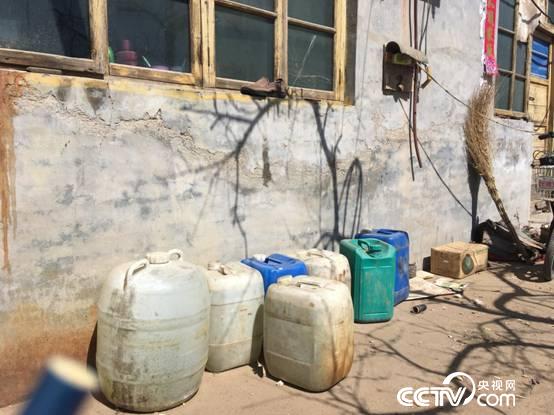
Drinking water transported from the village stored in the residents’ courtyard of cattle-raising community. (Photo/Xu Hui)
Relevant local authorities have been involved in the investigation.
On March 28th, the People’s Government of Xingtang County reported that a joint investigation team had been set up and rushed to the scene at the first time to carry out investigation and handling quickly.
On the morning of March 28th, Xingtang County Ecological Environment Branch entrusted Hebei Puni Testing Technology Co., Ltd. to sample and test the reported water wells, drinking water in upstream villages and irrigation water from machine wells. The Cary Township Government and the Development Zone Management Committee in neighboring areas have arranged personnel to investigate the groundwater situation of nearby villages and enterprises.
On March 30th, WeChat official account, the official WeChat of Shijiazhuang Ecological Environment Bureau, reported that it had been instructed to set up a special working group composed of the Municipal Ecological Environment Bureau, Xinle City, Xingtang County and relevant departments directly under the municipal government.
The working group went to the site overnight to carry out work, investigate and understand the situation, carry out sampling monitoring, and experts from provincial environmental monitoring, environmental geology and hydrology went to the site for consultation and guidance. At the same time, the surrounding enterprises are investigated by pulling the net.
Shijiazhuang Municipal Party Committee and Municipal Government have a firm attitude, and will find out the reasons as soon as possible, and seriously investigate and deal with environmental violations that may be involved in accordance with the law. After finding out the reasons, speed up the rectification and respond to social concerns.