Japan’s Fukushima nuclear pollution water discharged into the sea into the countdown "nuclear" discharged into the sea, endangering the world.
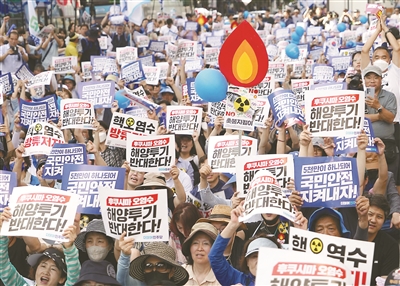
South Korea’s largest opposition party, the Common Democratic PartyOn July 1st, the Pan-National Conference on Condemning the Marine Discharge of Nuclear Contaminated Water in Fukushima was held in downtown Seoul, condemning the Japanese government’s plan to discharge nuclear contaminated water into the sea, and urging the South Korean government to clearly express its opposition to the discharge of nuclear contaminated water from Japan. The picture shows that on July 1, people held a rally in Seoul, South Korea with slogans such as "Opposing the discharge of Fukushima nuclear polluted water into the ocean". Xinhua News Agency (photo by Sang Ho Lee)
On the evening of July 5, nearly 100 Japanese people held a rally in front of the headquarters of Tokyo Electric Power Company (hereinafter referred to as TEPCO), the operator of the Fukushima Daiichi nuclear power plant, to protest against the plan to discharge nuclear polluted water into the sea in Fukushima. The day before, the International Atomic Energy Agency (IAEA) released a comprehensive assessment report on the nuclear polluted water in Fukushima. Japanese media said that kishida fumio will finally decide the time to start discharging nuclear polluted water into the sea on the basis of evaluating the contents of the report. On the morning of the 4th, Wu Jianghao, China’s ambassador to Japan, held a special press conference on the nuclear polluted water in Fukushima, Japan, pointing out that the IAEA assessment report could not prove the legitimacy and legality of the sea discharge, and could not exempt Japan from its moral responsibility and obligations under international law.
The Japanese government forced the Fukushima nuclear polluted water to be discharged into the sea, which caused widespread international concern and worry. Where does a lot of nuclear polluted water come from? Why does Japan take the world by storm to unilaterally and forcibly discharge nuclear polluted water into the ocean, and what harm will this move bring? The reporter interviewed relevant experts.
Produce about every day130 tons of nuclear contaminated water, more than 1.3 million tons of nuclear contaminated water have been accumulated after the accident.
On March 11th, 2011, an earthquake measuring 9 on the Richter scale occurred in the Pacific Ocean in northeastern Japan, which triggered a tsunami. The Fukushima Daiichi nuclear power plant lost power due to seawater injection, and the cores of units 1 to 3 melted, causing catastrophic nuclear leakage. The accident level was designated as the highest level of nuclear accident, level 7 (catastrophic accident).
In order to control the temperature of nuclear reactors, Tokyo Electric Power Company continues toCooling water is injected into the containment of units 1 to 3 to prevent the core from further melting and damage. "These cooling water, together with the groundwater and rainwater seeping into the reactor, form a large amount of nuclear polluted water. According to public information, the cooling process produces about 130 tons of nuclear polluted water every day, and more than 1.3 million tons of nuclear polluted water have accumulated after the accident. " Chen Zhi, associate professor of China University of Science and Technology and executive director of China Radiation Protection Society, told the reporter.
The Japanese government isIn April 2021, the plan to discharge nuclear polluted water into the sea was announced, and in July 2022, the plan to discharge nuclear polluted water into the sea was officially launched. At present, these nuclear polluted waters are collected in thousands of metal storage tanks in the Fukushima Daiichi nuclear power plant. According to estimates, these storage tanks will reach the peak capacity in early 2024. As henry puna, Secretary-General of the Pacific Islands Forum, said, Japan wants to "open Pandora’s box".
In Japan, the voice against the discharge of nuclear polluted water into the sea has never stopped. According to Japan’s "Fukushima Min Bao" report, the Federation of Fishery Associations of Fukushima Prefecture held a plenary meeting a few days ago and unanimously adopted a special resolution to emphasize its opposition to the nuclear pollution water discharged from Fukushima.Nothing has changed. This is a special resolution with the same content adopted by Japanese fishing groups after the Japanese All-Fishing Federation recently passed a special resolution against the discharge of nuclear polluted water into the sea.
Opposition from the international community is even stronger. Korean citizens’ groupsThe "National Action to Prevent Japan’s Radioactive Contaminated Water from Discharging into the Sea" recently held its third large-scale rally since May this year near the Seoul Metropolitan Government, with thousands of participants. People hold high slogans such as "Protect the Pacific Ocean" and "Sue Japan to the International Tribunal for the Law of the Sea", demanding that Japan adopt an alternative scheme of keeping Fukushima nuclear polluted water on land.
Fishery groups, such as the Federation of Fishery Operators of Korea, recently held a protest rally around the pier of Wandao Port, Wandao County, Jeollanam-do, condemning Japan’s plan to discharge nuclear polluted water into the sea, which is bound to seriously damage the livelihood of Korean fishermen and aquaculture practitioners and threaten people’s health and life safety.
Affected by geographical location and ocean currents, Pacific island countries are expected to be greatly affected by the discharge of nuclear polluted water from Fukushima.On June 26th, Henry Puner issued a statement that Japan’s plan to discharge radioactive waste into the Pacific Ocean is not only a nuclear safety issue, but also related to the marine environment, fisheries, people’s health and the interests of future generations. This move has obvious cross-border and intergenerational effects, which may constitute an international precedent for the intentional discharge of nuclear waste into the sea, and other disposal methods should be sought.
In the Philippines, many groups expressed their concern about Japan’s discharge of nuclear polluted water. Rohnell, a spokesman for Pamarakaya, a Philippine national fishery NGO, said:"Like many countries in Asia, we strongly oppose Japan’s discharge of nuclear polluted water into the Pacific Ocean, which will pollute our rich marine resources and cause extensive disasters to the Philippine fishery."
Recently, South Korean media and others have continued to report that Japanese officials have exerted undue influence on the conclusions of the comprehensive evaluation report of the International Atomic Energy Agency in various ways. This has aggravated the international community’s doubts and concerns about Japan’s nuclear pollution water discharging into the sea.
"The agency report cannot be a’ amulet’ and a’ passport’ for the Japanese side to discharge the sea." In response to a reporter’s question on the IAEA’s comprehensive assessment report on the disposal of nuclear contaminated water in Fukushima, China, a spokesman for the Ministry of Foreign Affairs said that the report failed to fully reflect the opinions of all experts involved in the assessment, and the relevant conclusions were not unanimously recognized by all experts. Due to the limitation of authorization, the agency did not review the legitimacy of the Japanese sea discharge plan, did not evaluate the long-term effectiveness of the Japanese purification device, and did not confirm the true accuracy of the Japanese nuclear polluted water data. The relevant conclusions were quite limited and one-sided.
The total amount, complex composition and long disposal cycle of Fukushima nuclear polluted water are unprecedented.
In the face of doubts and objections from all sides, Japan has never made a scientific and credible explanation on key issues such as the legitimacy of the sea discharge scheme, the authenticity of nuclear polluted water data, technical reliability, the effectiveness of purification devices, and the uncertainty of environmental impact, nor has it conducted full and meaningful consultations with various stakeholders, including neighboring countries. Instead, it has been constantly entangled.The term "nuclear polluted water" claims to discharge "treated water" purified by the so-called "multi-nuclide removal system" (ALPS), and even equates Fukushima nuclear polluted water with the discharged water under the normal operation of nuclear power plants around the world, and tries every means to "wash white" and discharge it into the sea.
"Fukushima nuclear polluted water is essentially different from the water discharged during normal operation of PWR nuclear power plants." Chen Zhi said that normally operated PWR nuclear power plants usually have two sets of water circulation systems, namely, the primary loop system and the secondary loop system, and the water in these two loops is not discharged during normal operation. Among them, the seawater used for cooling the secondary condenser and the water in the cooling water system of the equipment are not radioactive or have a very small amount of radioactivity. Fukushima nuclear pollution water comes from cooling water, rainwater and groundwater injected into the damaged reactor core, which is in direct contact with damaged nuclear fuel or nuclear waste and contains a large number of high radioactive nuclides.
According to the Japan Broadcasting Association,The nuclear polluted water treated by ALPS will be injected into a tank the size of a swimming pool. Every second, about 6 liters of treated water will be injected into about 4 tons of seawater at one time, and then these diluted water will be discharged into the Pacific Ocean through submarine pipelines.
pass byWith the purification of ALPS system and seawater dilution, has the nuclear polluted water become safe and harmless?
"The total amount of nuclear polluted water in Fukushima is large, the composition is complex, and the disposal cycle is unprecedented." Chen Zhi believes that the sea discharge will last for 30 years or even longer, and a large amount of nuclear polluted water will be generated in the future. Japan cannot prove the long-term reliability of the nuclear polluted water purification device and the effectiveness of the purification capacity, nor can it come up with a systematic and comprehensive environmental monitoring plan. The monitoring scope is too small, the number of points is too small, and the frequency is insufficient, so it is difficult to find out the abnormal situations such as excessive discharge of nuclear polluted water in time.
Fukushima nuclear contaminated water containsThere are more than 60 kinds of radionuclides, many of which have no effective treatment technology at this stage. Ken Bussler, a senior researcher in woods hole oceanographic institution, USA, goes to Fukushima for relevant research almost every year. "TEPCO only tested a few of the thousands of water storage tanks and did not conduct a thorough test and analysis." Ken Buselle said in an interview with the media that the test results of each jar are different. Some jars may have high tritium content and low cesium content, while others may have low cesium content and high strontium -90 concentration, which has great uncertainty.
For a long time, TEPCO has a bad track record in the safe operation of nuclear power plants, and has repeatedly concealed failures of nuclear power units, tampered with technical data and submitted false reports. Katsumi Ogawa, a scholar at the Graduate School of the University of Tokyo, told Tokyo News that up to now, a third party still can’t confirm the radioactive data in the Fukushima Daiichi nuclear power plant, so we can only discuss it with the data unilaterally released by TEPCO."Whenever I see all kinds of faults and problems of TEPCO, I can’t help but doubt whether the company can abide by the rules for a long time to dispose of nuclear polluted water."
On June 5th, a report from TEPCO was made public: the content of radioactive element Cesium in the marine fish, Sesquilla hsueh, caught in the harbor of Fukushima Daiichi nuclear power plant in May reached 18,000 Bekkerel per kilogram, which was 180 times higher than the standard set by Japanese food hygiene law. On the same day, Zhang Kejian, director of China’s National Atomic Energy Agency and director of the China of the International Atomic Energy Agency, made a speech on the discharge of Fukushima nuclear polluted water into the sea when attending the IAEA Board of Governors in Vienna in June, and severely criticized Japan for discharging Fukushima nuclear polluted water.
"There are still many radionuclides in the nuclear polluted water after ALPS treatment, and the maturity and effectiveness need to be verified; The ALPS system needs to dispose of more than 1.3 million tons of nuclear polluted water in a period of up to 30 years, and the performance and efficiency of long-term high-load operation are doubtful. " Zhang Kejian said that many nuclides have no effective treatment technology, and some long-lived nuclides may spread with ocean currents and form biological enrichment effects, which will bring unpredictable effects on marine ecology and human health.
The environmental threat posed by nuclear polluted water entering the sea will affect generations.
The half-life of radioactive elements in nuclear polluted water ranges from ten years to thousands of years. Chen Zhi mentioned that the dumping of nuclear waste water from the Fukushima accident in Japan into the sea will result in a high concentration of radionuclides in some sea areas, which will be enriched in marine organisms in this area and then enter the human body through the food chain, which will affect the human body by internal irradiation.
"From the perspective of food safety, if the amount of radionuclides in seafood exceeds the limit requirements of Chinese laws and regulations, it will be banned from sale. From the perspective of radiation protection, we focus on the risk of cancer and other diseases. This is a random probability problem, but the probability of occurrence is directly related to the radiation dose. " Chen Zhi said.
"Substances such as cesium -137 and cesium -134 may take weeks or months to be excreted, and strontium -90 or plutonium will be deposited in bones, which may be excreted several years after you ingest it, causing long-term damage." Ken Bucelle said.
The German marine scientific research institute once pointed out that the Fukushima coast has the strongest ocean current in the world, from the date of discharge.Within 57 days, radioactive materials will spread to most parts of the Pacific Ocean, three years later, the United States and Canada will be affected by nuclear pollution, and 10 years later, it will spread to global waters, affecting global fish migration, offshore fishing, human health, ecological security and other aspects, and the potential threat to human society and marine ecological environment health is incalculable.
Many scientists and environmental protection organizations say that due to the huge volume of nuclear waste water and the limitations of existing technology, it is impossible to fully predict what potential harm the discharged waste water will cause to the marine environment and human safety. Even if Japan calls itThe statement that "the concentration of pollutants reaches the standard after being diluted by a large amount of seawater" only means that the probability of immediate toxicity of related elements is reduced, and as a large amount of nuclear wastewater continues to flow into the Pacific Ocean, the total amount of radioactive materials will not decrease, and the environmental threat posed by nuclear polluted water entering the sea will affect generations.
In 2021 and 2022, China’s Ministry of Ecology and Environment organized the monitoring of marine radiation environment in the sea areas under China’s jurisdiction, and found out the background of marine radiation environment in relevant sea areas at present. "In view of the monitoring of marine radiation environment after the nuclear polluted water in Fukushima, Japan is discharged into the sea, our department has made arrangements, and will give an early warning if any abnormality is found, so as to earnestly safeguard our national interests and people’s health." The relevant person in charge of the Ministry of Ecology and Environment (National Nuclear Safety Administration) said.
"The problem of nuclear pollution of water and the health hazards of radiation may not show further influence until 100 years later. The problem of nuclear polluted water must consider the impact after 500 years and 1000 years. " Fifty Lan Yilong, the representative director of the Japan-China Common Market Promotion Association, recently called on the Japanese government to strengthen cooperation with the international community on the disposal of nuclear polluted water and pool global wisdom to study better disposal schemes other than sea discharge. "The sea is the common property of the world and cannot be decided by Japan alone."
It is neither moral nor legal to transfer the risk of nuclear pollution to the whole world.
"I have a question that I have to ask. If the nuclear polluted water treated by ALPS is so safe, why doesn’t Japan reuse it or use it in its own manufacturing and agriculture?" Fiji’s Deputy Prime Minister (then Acting Prime Minister of Fiji) Kamikaga once issued a "question of the soul".
Since the middle of the last century, the sea area where the Pacific island countries are located has become a nuclear testing ground for American and Western countries, which has suffered shocking nuclear radiation pollution and ecological disasters."According to our lessons in nuclear pollution, it is unthinkable for Japan to continue to push forward the sea discharge plan at this time. We can’t use 40 years to’ figure out’ the consequences of Japan’s exclusion from the sea. " Henry Puner emphasized that any decision on the disposal of nuclear polluted water is not and should not be a domestic issue of Japan, but a global and transnational issue, which should be reviewed within the scope of international law obligations.
In fact, the Ministry of Economy, Trade and Industry of Japan originally proposedFive disposal schemes of nuclear polluted water, including formation injection, discharge into the sea, steam release, hydrogen release and underground burial. In February, 2020, an expert committee organized by the Ministry of Economy, Trade and Industry of Japan submitted a report, arguing that "the most practical solution" is to dilute the nuclear polluted water and discharge it into the sea or evaporate it into the atmosphere.
Discharging the sea is by no means the safest and most optimized disposal method. Why did Japan decide to discharge nuclear polluted water into the sea? The answer is obvious: the economic cost is the lowest and the pollution risk to Japan itself is the smallest.
"The Japanese government unilaterally decided to discharge the nuclear polluted water into the ocean without fully demonstrating other disposal schemes. This practice of harming the common interests of all mankind for its own self-interest cannot convince people at home and abroad." China’s Foreign Ministry spokesman Wang Wenbin said.
It is neither moral nor legal to transfer the risk of nuclear pollution to the whole world. Chen Zhi said that the plan of discharging nuclear polluted water into the sea violates the principle of legitimacy of radiation protection. This also violates the obligation to protect and preserve the marine environment stipulated in international law such as the United Nations Convention on the Law of the Sea, andThe 1972 London Convention on Dumping of Wastes prohibits the dumping of radioactive wastes into the sea through artificial structures at sea.
On the earth, there are three parts of land and seven parts of ocean. The ocean is the cradle of life on earth. Faced with millions of tons of nuclear polluted water, Japan should respect facts and science, and handle it carefully and properly in a highly responsible attitude and spirit to all mankind. (Author: Chai Yaxin) zll

