"Grandpa Specimen" and his wonderful "Zoo and Botanical Garden"
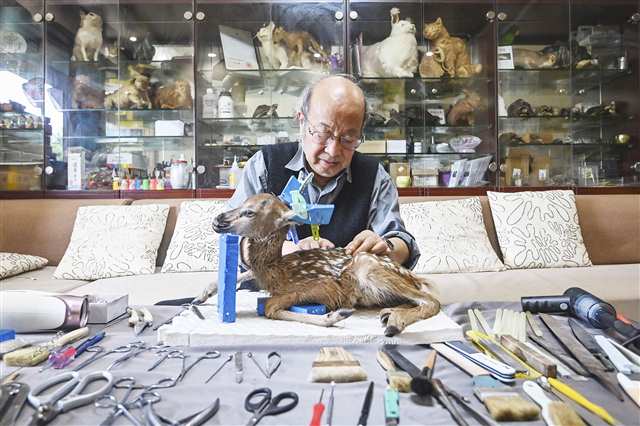
On April 10th, Tang Anke was making specimens at home in Shidayuan Community, Huxi Street, Chongqing High-tech Zone.
On April 10th, the spring rain fell like silk. The reporter went to Tang Anke’s home in Shidayuan Community, Huxi Street, Chongqing High-tech Zone. Unexpectedly, as soon as I stepped into the door, I was stunned and couldn’t help but "wow"-
A wall of display cabinets and bookcases, even on the top of cabinets, sofas, tables, cabinet air conditioners, and TV cabinets are full of animal specimens, which is dizzying; At the door of the kitchen and the corridor of the bedroom, piles of wooden specimen frames are neatly stacked, including animal specimens and plant specimens, and some even stack higher than people.
"Is this home? This is clearly a’ zoo and botanical garden’! " Hearing this sigh, Tang Anke smiled cheerfully. "There are more than 6,000 specimens, large and small." He said.
Tang Anke, 72, has been dealing with specimens for more than 40 years and is called "grandpa of specimens" by many people. His hands can "turn decay into magic", bring all kinds of animals back to life and plants "never wither", and show the beauty of biodiversity.
An accident
From drawing biological ink line diagram to groping for specimen making
On the white foam board, there is a petite sika deer, its limbs are bent and its back is slightly raised, which looks quiet and elegant. Although its eyes have lost the light of life, they can still see a trace of curiosity and keenness.
Tang Anke carefully fine-tuned the posture of sika deer, fixed all parts with specimen needles, and did not ignore any details. "This sika deer probably died shortly after birth. When I got it, its right hind leg was broken and it could only be made into a sitting position." Such a shaping and shaping process will take a long time. He said that every animal has its own characteristics, and all he has to do is to make the specimen as close to nature and true as possible.
Tang Anke’s "into the pit" specimen making is an accident.
In 1978, Tang Anke entered the Biology Department of Chongqing Normal University (now College of Life Sciences of Chongqing Normal University) and worked as a botany experimenter. In addition to preparing experimental equipment for students, he also has an important job, that is, drawing biological ink lines. Bio-ink-line drawing, like a photo on a plant’s "identity card", is not only necessary for basic botany documents such as flora, but also necessary for botanists to have ink-line drawing as a basic drawing every time they publish a paper on new plant species. Teachers and students collected a lot of plant specimens from various places, and built plant specimen rooms and specimen storage cabinets, all of which were drawn by him.
Later, in the process of managing the herbarium, Tang Anke found that the weather in Chongqing was humid. In order to prevent insects and mildew, mothballs were placed in each specimen storage cabinet. However, mothballs are not only pungent in taste, but also have unsatisfactory insect-proof and mildew-proof effects.
In the 1990s, he began to manage the animal specimen room again and found similar problems. He said: "Some precious animal specimens are infected with worms, and their limbs are mutilated by worms, which makes my heart ache very much."
Since about 2000, many flora and vegetable variety records have been compiled, and new plant species have been published less and less. Tang Anke, who has few pictures to draw, began to devote a lot of energy to the research and exploration of specimen making.
"As an experimenter for so long, I have come into contact with many animal and plant specimens and occasionally learn to make them. I really like them. More importantly, I want to solve the problems I found before. " He said.
In this way, he changed from a painter to a taxidermist.
An insistence
The "King of Invention" won five national invention patents.
Today, Tang Anke, who has retired for nearly 13 years, has transformed his home into a "laboratory"-
On the balcony, there are large and small plastic buckets, enamel pots and stainless steel pots, many of which contain solvents and specimens being made. On the coffee table in the living room, boxes and plates are filled with tools, scissors, tweezers, scalpels, insect needles and syringes … In the display cabinets, sewing machines and beside the sofa, there are all kinds of consumables for making specimens that he hoards everywhere.
After retirement, he has always insisted on this love, and he has never been "flat" for a day. Every day, he shuttles back and forth between the living room and the balcony to make specimens.
In order to make animals and plants "reborn" better, he also spent a lot of thoughts and brains to form his own "unique cheats".
There are many kinds of specimens, one of which is animal-skinned specimens, which are often used in mammals, birds, reptiles and large fish. However, in the past, this kind of specimen was usually preserved by smearing toxic drugs on the endothelium, such as formaldehyde and arsenic. "It is ok for this kind of specimen to be displayed in the specimen room or the specimen library, but it is limited to exhibit and even enter the homes of ordinary people." Tang Anke said.
For this reason, he invented a treatment liquid which is simple in operation, non-toxic, low in cost and can effectively prevent corrosion for a long time. When making animal skinning specimens, after peeling, degreasing and other procedures are carried out according to the conventional specimen making technology, this treatment solution is used for soaking, and then the surface treatment solution is cleaned, and then it is filled and shaped. In this way, the finished specimen does not need to be treated with any toxic drugs, which is more friendly to people and makes the specimen better preserved. "The specimens I made by this method have been preserved for the longest time for more than 10 years, and there have been no problems such as insects and mildew." He said.
Immersed specimens are also one of the common types of specimens, which need long-term immersion and preservation. Among them, traditional soaking animal specimens are mostly soaked in formaldehyde. He independently developed the technique of dry whole preservation of animal specimens, which not only realized non-toxic, insect-proof and mildew-proof, but also preserved all the muscles, bones and fur of animals before their death.
Birds and animals are fine and lifelike; Plants have bright colors and clear stems and veins; Insect’s thin wing stripes are exquisite and transparent as gauze … His "unique secret book" makes animals and plants "live".
At present, as the first inventor, he has won five national invention patents and one utility model patent, becoming the "king of invention" and "innovator" in the eyes of others.
A wish
Help more primary and secondary schools to build specimen rooms.
More than 6,000 pieces, which is an amazing number. But Tang Anke has not stopped, and his wonderful "Zoo and Botanical Garden" is still adding new members.
Today, he will go to the nearby mountains to collect specimens. He said that the Jinyun Mountains, which extend from north to south, are a treasure house of resources. Every time he travels, he will also pay special attention to which ones can be brought back for specimens. "Others bring specialties, and I am picking up specimens."
Last year, during the National Day holiday, he and his family traveled to Rushan, Shandong Province and picked up many crabs. After coming back, he also bought some online, and spent two months making them into specimens and mounting them in four exquisite big boxes.
King Crab, Xu Crab, Wide-body Big-eyed Crab, Big Hook Crab, Red Crab, Strong Rhombus Crab, Couple Crab, General Crab, Spider Crab … The crabs in the specimen box have different shapes and are vivid. "In the past, these crabs could only be made into immersed specimens. With my technology, they can be preserved as a whole." He said proudly.
Sometimes, relatives and friends, neighbors will send him some pets who died of illness or accident. Even strangers, after hearing about Tang Anke, sent him their beloved pets in the hope that he could make them into specimens.
He said that the specimen is silent, but it allows life to "continue" in another way, and also makes the pet owner’s emotions pinned.
With more and more specimens, Tang Anke also became famous in the circle. Under the recommendation of his friends, he received invitations from some primary and secondary schools one after another, asking him to take specimens to the school to hold exhibitions. At present, his specimens have been exhibited for public welfare for 46 times.
"Many animals and plants, children have only seen in textbooks, and even have never seen them in textbooks. They were all very excited when they saw the specimens. " He said that he was sincerely happy to see the children like it so much.
These specimens can help children understand the morphological characteristics of animals and plants more intuitively, understand the biodiversity of nature, open a door for them to explore the natural world, and plant a seed in their hearts that loves nature, advocates science and respects life. "This is their most important significance and value." Tang Anke said.
For this reason, Tang Anke’s greatest wish is to pass on his "unique cheats" and play a greater role, so that more primary and secondary schools can establish specimen rooms and specimen museums.
In addition, he has an idea to "move" this "animal and botanical garden" at home to a more spacious and open place, so that these specimens can be better exhibited and seen by more people, and the public’s awareness of biodiversity and natural ecological protection can be enhanced.
Maybe by then, he will be reluctant. But he still thinks it’s all worth it.
New Chongqing-Chongqing Daily Chief Reporter Long Fan/Tu Zhang Yizhu/Wen