Economic Situation of Pacific Island Countries in 2019

# Editor’s Note: The economic structure of Pacific island countries is single and fragile, their development is heavily dependent on external forces, their self-development ability is insufficient, and their internal differentiation is wide. With the accumulation of investment, the development of major projects and the improvement of infrastructure, the development potential of Pacific island countries is gradually being released, and the overall economic operation is improving. However, due to its own characteristics, its shortcomings and risks are still outstanding, and it is necessary to make precise policies, make overall plans and formulate systematic and comprehensive solutions.

Wen | Zhou Yuyi, Yang Yang, Hu Zhenyu China (Shenzhen) Institute of Sustainable Development and Marine Economy.
I. Regional characteristics of Pacific island countries and their economic characteristics under their influence
(A) their own development capacity is insufficient
Pacific island countries have a total land area of about 520,000 square kilometers, a total population of about 11.068 million, and an economic aggregate of about 34.83 billion US dollars (2018). Among them, Papua New Guinea, as the island country with the largest land area and population, has a land area of about 453,000 square kilometers, a total population of about 8.606 million and an economic aggregate of about 24.45 billion US dollars, accounting for 87.6%, 77.8% and 70.2% of the total number of Pacific island countries respectively. The remaining 13 island countries have a total land area of less than 70,000 square kilometers, a total population of about 2.462 million and an economic aggregate of only 103. Nauru and Tuvalu, which have the smallest land areas, have land areas of 21 square kilometers and 26 square kilometers respectively, and their population size is only about 13,000. Niue, the island country with the least population, with a total population of more than 1,600, is a typical small country with few people.
Table 1-1 Overview of Pacific Island Countries in 2018
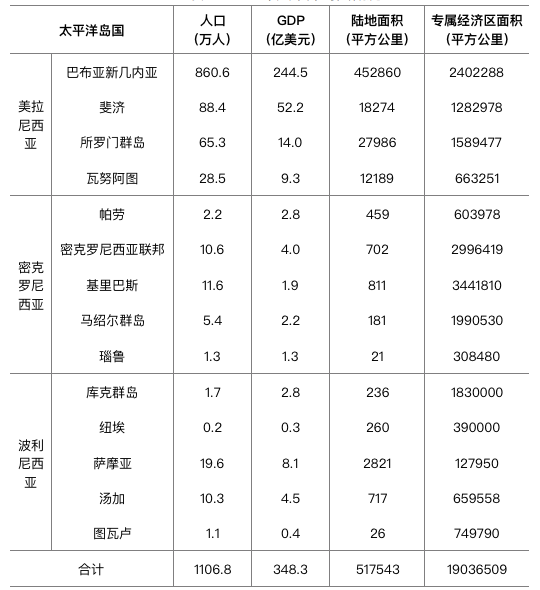
Source: World Bank statistics in 2018 and https://www.cia.gov/library/publications/resources/the-world-factbook/wfnext/region _ aus.html.
Due to the small and scattered land space, far from the world economic and social activity center, and the constraints of capital, talents, technology and engineering capabilities, the infrastructure level of transportation, energy, information and other Pacific island countries is low, the industrial base is weak, the self-development ability is seriously insufficient, and the social and economic development is generally lagging behind. For example, in terms of energy, the power supply in the Pacific island countries is seriously insufficient and the cost of electricity consumption is high. Among the total population of more than 11 million, there are more than 7 million people without electricity. Most island countries have not achieved full coverage of the power grid, and the electricity consumption gap is large. Among them, Papua New Guinea, as an island country with the largest land area and population, has the worst power supply capacity. The national power grid coverage rate is only 15%, and about 6.3 million people live in power-free areas. The electricity supply rates in Vanuatu and Solomon Islands are only 30% and 20%.
From the perspective of economic development, Pacific island countries are typical resource-dependent economies, and industrial development is mainly determined by resource endowments such as agriculture, fisheries, minerals and tourism. Therefore, most island countries are limited by land space and mineral resources, and the proportion of primary and tertiary industries is relatively high. The development of secondary industry is generally lagging behind, and mining and a small amount of light industry are the mainstay (light industry mainly processes fish products, wood, coconut and sucrose), and most other industrial products rely on imports. Countries such as Kiribati, Solomon Islands and Micronesia (Federated States of) still take fishery and agriculture as their pillar industries. Among them, Kiribati’s fishery accounts for 71.7% of national income (2018); Fiji, Palau, Samoa, Vanuatu, Cook Islands and other countries have relatively developed tourism, and the proportion of tertiary industry is obviously high; The relatively prominent secondary industry is mainly Papua New Guinea, Solomon Islands, Fiji and other countries with relatively large land area and rich mineral resources. Nauru has a small land area, but it once dominated the national economy due to the enrichment of phosphate minerals, and now it is almost exhausted. In addition, wood processing in Papua New Guinea and Solomon Islands, sugar industry in Fiji, fish products processing, soap making and coconut oil processing in Micronesia, and food, tobacco, beer and soft drinks processing in Samoa also have a certain foundation.
Table 1-2 Comparison of Three Industrial Structures and Key Industries of Major Pacific Island Countries
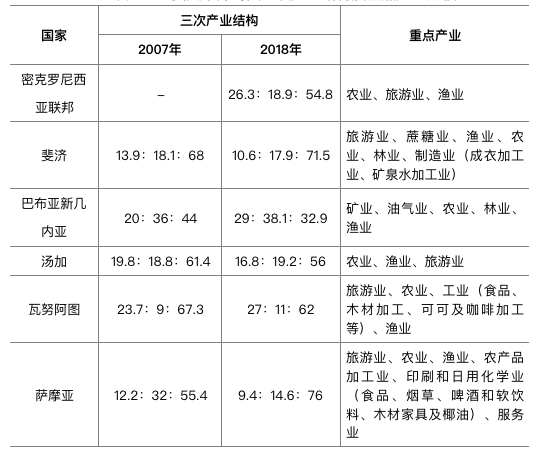
Source: Guide to Foreign Investment Cooperation Countries (Regions) (2019), and the data of Fiji’s tertiary industrial structure are in 2017.
(B) the living and development environment under tight constraints
Pacific island countries live deep in the ocean, mostly in the earthquake-active zone around the Pacific Ocean, with small territory and low altitude. They have been threatened by natural disasters such as earthquakes, volcanoes and tsunamis for a long time, and they are also facing the enormous survival pressure of global warming and rising sea levels.
First, the Pacific island countries are located at the junction of the Pacific plate, the Eurasian plate, the Indian Ocean plate, the American plate and the Antarctic plate, and most of them are located in the volcanic seismic belt around the Pacific Ocean. They have frequent geological activities all year round and are facing natural disasters such as earthquakes, volcanic eruptions and tsunamis.
Second, the Pacific island countries are also one of the regions with the most frequent typhoon activities, and the typhoon transit has caused great losses to the island countries. For example, Typhoon Aita in April 2014 directly affected more than 12,000 people in Papua New Guinea. In March 2015, tropical storm Pam hit Vanuatu hard, and 90% of houses in the capital Port Vila were damaged by the storm. In 2018, there were 126 recorded typhoons/hurricanes/tropical storms in the world (110 were named and 16 were unnamed), including 53 in the northwest Pacific, 27 in the northeast Pacific and 8 in the south Pacific, accounting for 69.8% of the total.
Third, the Pacific island countries are mostly composed of small islands, with a low average altitude, and most of the population is concentrated in coastal areas, which is very seriously affected by climate change. Tuvalu, for example, is composed of seven ring-shaped coral reefs and two coral islands distributed on the sea surface of 800 square kilometers, with a land area of only 26 square kilometers and a maximum altitude of only 5 meters. According to the sea level rise rate from 1993 to 2012, 60% of its land will sink into the sea by 2062. In 2011, Tuvalu warned that if it did not slow down the global warming, the country would face extinction. Other countries such as Nauru, Kiribati, Vanuatu and other island countries are also facing similar problems.
(C) internal development differentiation disparity
The Pacific island region consists of more than 10,000 islands, which are distributed on the Pacific Ocean surface of about 30 million square kilometers and belong to Melanesia, Micronesia and Polynesia. Due to the large number of islands, scattered distribution, and great differences in resource conditions and political, economic and cultural backgrounds, there is a huge disparity in development between different archipelagos and between different island countries.
Melanesian Islands mainly include Papua New Guinea, Solomon Islands, Fiji, Vanuatu, etc. Most of them are continental islands, with relatively large land area, large population, and relatively rich land mineral resources, which have good conditions for developing metal and agricultural processing industries. Therefore, the economic scale is relatively large. The GDP of Papua New Guinea, Fiji, Solomon Islands and Vanuatu in Melanesia accounts for 92% of the total economic output of Pacific island countries. Micronesia Islands means "small island islands", which mainly includes Palau, Micronesia (Federated States of), Marshall Islands, Kiribati and Nauru. They are mostly composed of a series of atolls and scattered islands, with the smallest population and economic aggregate among the three archipelagos. However, due to the large number and wide distribution of islands, the exclusive economic zone is the largest, totaling 9.34 million square kilometers, accounting for 49% of the entire Pacific island countries. Polynesian islands mainly include Cook Islands, Samoa, Tuvalu, Niue and Tonga, and are dominated by volcanic islands and coral reefs, with smaller land area, population size and economic scale, but higher than Micronesia. From the main indicators, the socio-economic development level of Pacific island countries is closely related to population size and industrial characteristics, and the internal differences are very significant. For example, Papua New Guinea, Solomon Islands and Vanuatu, located in Melanesia Islands, are in the forefront in population scale and economic scale, but the per capita GDP and the proportion of urban population are low. Among them, the proportion of urban population in Papua New Guinea is only 15%, that is, 85% people live in rural areas.Engaged in low-level agricultural activities, therefore, the per capita GDP is only about 3,000 US dollars. The proportion of urban population in Solomon Islands and Vanuatu is below 30%, and the per capita GDP is only $2,200 and $3,254 respectively. Fiji has a total population of 926,000, second only to Papua New Guinea. However, due to relatively good infrastructure conditions and developed tourism, the per capita GDP is US$ 5,870. At present, Fiji has become an important tourist center in the Pacific region, receiving more than 800,000 international tourists annually, accounting for about 50% of the total international tourists received by Pacific island countries, and its tourism revenue is equivalent to 20% of GDP. On the contrary, Cook Islands and Palau have a small population, a small burden of economic development, and rapid growth. The per capita GDP has exceeded 10,000 US dollars, and the proportion of urban population has reached a very high level. However, Samoa, Kiribati, Micronesia (Federated States of), Marshall Islands, Tonga and other countries have relatively large population, low industrial structure and relatively low per capita GDP.
Table 1-3 Comparison of Per Capita GDP and Urban Population Proportion of Pacific Island Countries in 2018
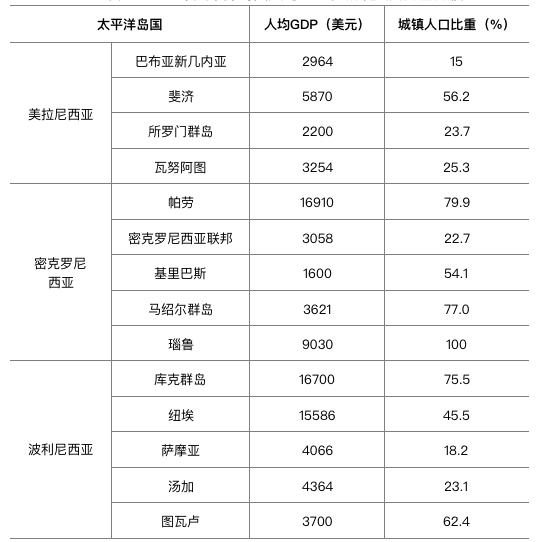
Source: World Bank, websites of China embassies in various countries, http://zh.tradingeconomics.com/country-list/gdp and other public information.
(D) Independent development has a long way to go.
After the era of great navigation, the Pacific islands were gradually incorporated into the western colonial system. After World War II, it gradually became independent. After World War II, the Pacific island countries became more and more independent, and Western Samoa, Nauru and Fiji became independent successively. With Palau’s independence on October 1, 1994, the United Nations Trusteeship Council also ended its mission. Although many Pacific United Nations Trust Territories have achieved nominal independence, due to their own conditions and historical reasons, the Pacific island countries are weak in self-development, which has been difficult for quite some time after independence. The common problems such as lack of government governance capacity, insufficient national cohesion, insufficient education of residents, and shortage of technical talents are prominent. In addition, they are far from the world market and have a single economic structure, which makes it difficult for Pacific island countries to form a benign self-growth mechanism, and they are still highly dependent on external forces today. For example, in 2017, Micronesia received $167 million in official development assistance, accounting for 48% of its GDP that year; Tonga receives various kinds of material assistance, project assistance and financial support every year, amounting to about 60 million to 70 million US dollars, accounting for about 15% of its GDP. Vanuatu receives about 17% of GDP from foreign aid every year. In 2017, Samoa received a total of $65.52 million in foreign aid, accounting for about 8% of its GDP.
At present, the major donors of Pacific island countries include Australia, China, New Zealand, the United States, Japan, the European Union and other international and regional organizations such as the Asian Development Bank, the World Bank, the Global Fund and the United Nations Development Programme. The main areas of assistance are agriculture, climate change and disaster reduction, education, medical and health care, and government capacity building. In the past decade, the total amount of assistance received by Pacific island countries from major countries (institutions) reached 13.3 billion US dollars, and it showed an increasing trend year by year.
Table 1-4 Assistance of Major Countries (Institutions) to Pacific Island Countries in 2011-2017
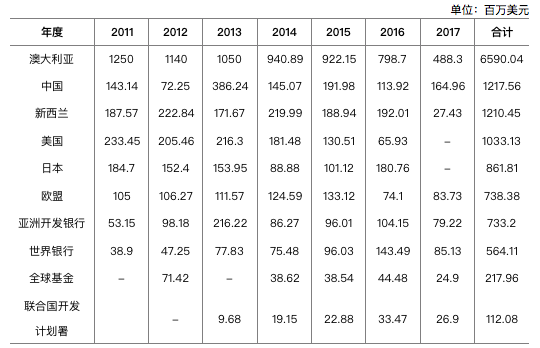
Source: Lowy Institute for International Policy, an Australian think tank.
Second, the current economic situation and development opportunities of Pacific island countries
(1) Economic situation
1. The ability to resist risks is low and fluctuates greatly with internal and external factors.
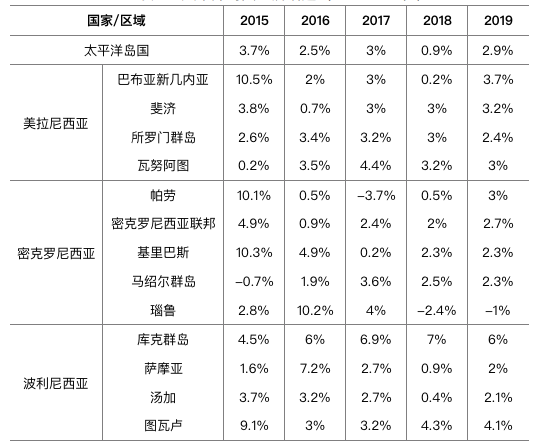
Pacific island countries have small economies, single structure and poor anti-interference ability, which are significantly affected by natural disasters, external situations and even single projects, and their economic development fluctuates greatly. Judging from the impact of natural disasters, in recent years, the number and intensity of tropical cyclones in the Pacific region have increased sharply, and strong earthquakes have occurred frequently, which has caused huge economic losses to Pacific island countries, especially several "big countries" in Melanesia, and directly led to economic fluctuations in the whole region. For example, in 2015, Hurricane Pam hit Vanuatu, and 90% of the houses in the capital Port Vila were damaged by the storm, resulting in losses accounting for 64% of its GDP, and the economic growth rate dropped from 2.3% in the previous year to 0.2%; In 2016, Hurricane Winston, the worst hurricane in the history of the Pacific Ocean, swept through Fiji, causing 130,000 people to be displaced, directly causing Fiji’s economic growth rate to drop from 3.8% in the previous year to 0.7% in that year; In 2018, a magnitude 7.5 earthquake occurred in Papua New Guinea, which caused great damage to the production facilities of major resource projects such as oil and gas industry (accounting for 20.2% of GDP) and gold, and had a strong impact on economic growth. Although post-disaster reconstruction and related activities of the Asia-Pacific Economic Cooperation (APEC) reduced its impact on the economy to a certain extent, the growth rate dropped to 0.2%; Tonga, located in Polynesia, suffered severe damage to crops, public infrastructure and buildings due to Hurricane Gita, and its economic growth rate in 2018 was only 0.4%.
From the perspective of the external situation, the economic characteristics of the Pacific island countries’ tourism market and export market, which depend heavily on the assistance of foreign forces, make their economies extremely sensitive to the external situation and fluctuate significantly with emergencies. For example, in 2017, Palau Pacific Airlines was forced to suspend all flights to and from Chinese mainland due to the sharp drop in Chinese mainland tourists, which accounted for nearly 50% of the inbound tourists, resulting in a sharp drop in the total number of inbound tourists and a heavy blow to the tourism industry. At the same time, tourism projects from Chinese mainland stopped working, which led to a serious decline in Palau’s economy, and the growth rate in that year dropped to-3.7%; In 2018, due to the continuous weak phosphate export and Australia’s reduction of funding for Nauru Offshore Refugee Center, Nauru’s economy shrank significantly, and its growth rate dropped from 4% in the previous year to -2.4%. In 2019, it continued to maintain negative growth and its growth rate narrowed to -0.5%.
Table 2-1 Economic Growth of Pacific Island Countries (2015-2019 [1])
Source: Asian Development Bank, Pacific Economic Monitor https://www.adb.org/publications/series/Pacific-economic-monitor.
2. The industrial structure is adjusted quickly, and the tertiary industry has sufficient power.
Restricted by geographical conditions and multiple factors such as transportation, resources, capital and technology, the industrial base of Pacific island countries is weak, and the three industrial structures are characterized by "big at both ends and small in the middle", that is, the scale of agriculture and service industry is relatively large, and the manufacturing industry is seriously underdeveloped. Limited by the land and technical conditions, it is difficult to make a big breakthrough in the growth space of agriculture. Therefore, the tertiary industry with tourism as the core has become the main driving force for industrial restructuring and social and economic development in Pacific island countries in recent years.
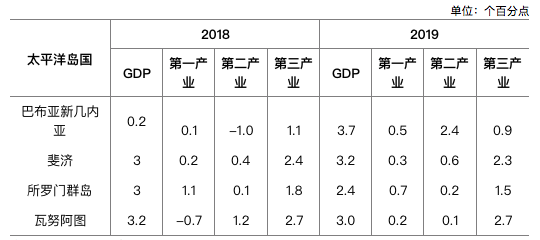
Judging from the contribution of three industries to GDP growth in recent years, the economic growth of Melanesia four countries mainly benefited from the rapid growth of service industry. For example, in 2018, Papua New Guinea was affected by a strong earthquake, and the oil, gas and mining industries were greatly impacted, which directly led to the secondary industry pulling down GDP by about 1 percentage point. However, thanks to the stimulation of the APEC summit, the tertiary industry pulled up GDP by about 1.1 percentage point, which finally made the economy maintain a positive growth of 0.2 percentage point throughout the year. From 2010 to 2018, the number of tourists in Fiji increased at an average annual rate of 5.5%. At present, tourism revenue has accounted for 1/5 of GDP, which plays an important role in its economic growth. In 2018, Fiji’s annual economic growth was 3 percentage points, of which the tertiary industry contributed 2.4 percentage points and the contribution rate reached 80%; In the same year, Vanuatu’s economy grew by 3.2 percentage points, and the tertiary industry contributed 2.7 percentage points, with a contribution rate of 84%.
Table 2-2 The Pulling of Three Industries to GDP in Melanesia (2018-2019)
Source: Asian Development Bank, Pacific Economic Monitor https://www.adb.org/publications/series/Pacific-economic-monitor.
In addition, the economic growth of island countries such as Cook Islands and Samoa in Polynesia is increasingly dependent on tourism. For example, from 2012 to 2018, the tourism revenue of Cook Islands accounted for an average of 49.6% of GDP; Samoa’s tourism revenue accounted for an average of 18.1% of GDP, rising to 20.6% in 2018, setting a new record.
3. The inflation rate is low and the overall impact is small.
Because there are many Pacific island countries, which are far apart, economically independent and relatively weak, there are significant differences in inflation among countries. But overall, the prices of Pacific island countries have remained stable in recent years. Despite frequent natural disasters and economic contraction, there has been no serious inflation or deflation, which has not had a serious negative impact on people’s livelihood.
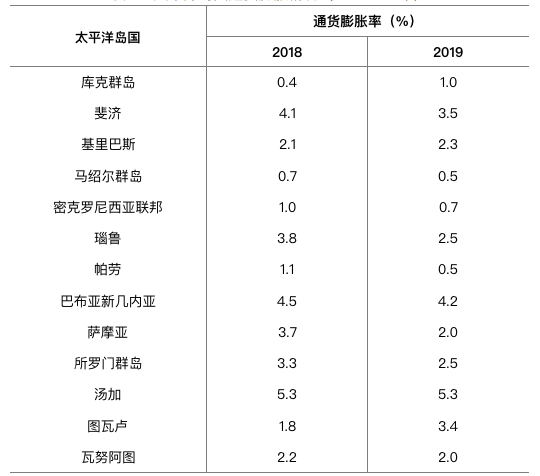
In 2018, among the 13 island countries with statistics, the inflation rates of 7 island countries were all below 3%, among which the inflation rates of Cook Islands, Marshall Islands and Micronesia (Federated States of) were below 1%. The countries with relatively high inflation rates are Tonga, Papua New Guinea, Fiji, Nauru and Samoa. Affected by Hurricane Gita, Tonga’s food prices rose significantly, leading to an inflation rate of 5.3%. Papua New Guinea was mainly affected by the strong earthquake and APEC summit, and the prices of goods and services generally rose. Among them, the price of medical care rose by 9.0%, the price of clothing and shoes rose by 8.3%, and the price of hotels and restaurants rose by 8.2% [2]. However, due to the increase of foreign exchange reserves and the shrinking of money supply, the inflation rate was only 4.5%, compared with the inflation rate of 6.7% caused by El Niñ o in 2016. Fiji is mainly due to the higher tariffs on tobacco and alcohol and the decline in the output of kava wine, which has led to a significant increase in beverages and tobacco, pushing the inflation rate to 4.1%; Nauru’s inflation rate has dropped from 9.8% in 2015 to 3.8% due to economic contraction and low global commodity prices (especially oil prices); In Samoa, the inflation rate rose to 3.7% mainly due to the sharp rise in the prices of domestic and imported commodities such as food and non-alcoholic beverages.
Table 2-3 Inflation in Pacific Island Countries (2018-2019)
Source: Asian Development Bank, Pacific Economic Monitor https://www.adb.org/publications/series/Pacific-economic-monitor.
4. The number of countries with fiscal deficits has surged, and the debt pressure has increased.
Due to the single financial source and the significant impact of economic fluctuations, Pacific island countries generally have high debts and outstanding fiscal deficits, which have caused serious problems to the sustainable development of social economy.
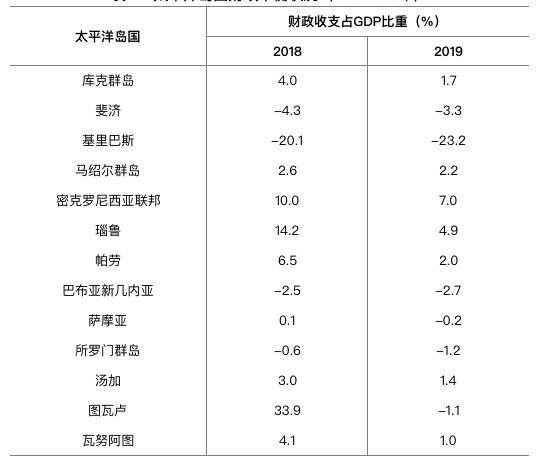
In 2018, the fiscal deficit of Pacific island countries was four, and preliminary statistics in 2019 showed that it had expanded to six. Among them, Kiribati is the most serious, with deficit ratio accounting for 20.1% in 2018 and rising to 23.2% in 2019. The main reason is that the salary expenditure has increased by 33.9%, and the purchase of aircraft by Kiribati Airlines has caused huge financial costs. Fiji’s fiscal deficit ratio in 2018 is 4.3%, which is about twice as much as that in 2017 (2.3%) due to the increase in operating and investment expenditures. At the same time, the proportion of government debt to GDP increased from 46.4% in 2017 to 50.0% in 2018. Although the financial deficit ratio of Papua New Guinea is not high, its foreign debt has been rising in recent years, and it will reach 13.6% of GDP in 2020, which will account for 44.8% of the total central government debt. After several years of expanding deficit, the Solomon Islands government has made great efforts to reduce the fiscal deficit ratio from 3.8% in 2017 to 0.6% in 2018 through a series of measures to increase the export tariff on logs. With the government’s investment in Tina River hydropower project, the fiscal deficit ratio will reach 1.2% in 2019, and it is expected that the fiscal deficit ratio will still expand slightly in 2020. Despite the severe impact of the disaster, Samoa achieved its first fiscal surplus in nine years in 2018 through strict expenditure control and high external grants, but the proportion of foreign currency debt to GDP is still as high as 49.4%.Tuvalu’s fiscal surplus will turn from positive to negative due to the continuous growth of infrastructure expenditure and the sharp decline of fishing income, and a fiscal deficit ratio of 1.1% will appear in 2019. Thanks to the budget support provided by development partners, Tonga achieved a fiscal surplus of 1.4% in 2018, but its foreign debt increased from 39.5% in 2017 to 41.8%.
Table 2-4 Financial Balance of Pacific Island Countries (2018-2019)
Source: Asian Development Bank, Pacific Economic Monitor https://www.adb.org/publications/series/Pacific-economic-monitor.
(B) Development opportunities
1. The global attention and influence of Pacific island countries have increased rapidly.
Pacific island countries live deep in the ocean, mostly in the earthquake-active zone around the Pacific Ocean, with small land area and low altitude. They have been threatened by natural disasters such as earthquakes, volcanoes and tsunamis for a long time, and they are also facing great survival pressure from global warming and rising sea levels. In developing economy and improving people’s livelihood, island countries are also faced with a series of core problems such as fragile ecological environment, weak industrial base and weak national strength. Faced with the dual dilemma of survival and development, the Pacific Ocean has a strong desire to warm up and win the support of the international community. In recent years, Pacific island countries have taken active actions and made great efforts on major issues related to their own survival and development, such as climate change, international cooperation, inclusive growth and sustainable development, using the existing regional cooperation mechanism and the international stage of the United Nations, and their global attention has rapidly increased, creating good conditions for them to carry out international economic and trade cooperation more extensively.
In 2014, Samoa successfully hosted the Third International Conference on Small Island Developing States; In 2017, Fiji became the president of the 23rd Conference of the Parties to the United Nations Framework Convention on Climate Change, which was the first time that a small island developing state seriously affected by climate change took the chair of the United Nations Climate Conference. In April 2018, the Pacific Islands Forum Economic Ministers’ Meeting was held in Palau, which attracted the extensive participation of institutions such as the Asian Development Bank, the Asian Infrastructure Investment Bank, the resident representative office of the International Monetary Fund, the Pacific Financial Technical Assistance Center, and private sector organizations in the Pacific Islands [3]; In November 2018, the 26th informal leadership meeting of the Asia-Pacific Economic Cooperation (APEC) was held in the Pacific island countries for the first time. As the only representative of APEC member countries in the Pacific island countries, Papua New Guinea received unprecedented attention from the international community.
2. Extraterritorial powers strengthen cooperation with Pacific island countries.
In recent ten years, with the promotion of the international status of Pacific island countries and the increasingly prominent strategic position of the region, Australia, New Zealand, the United States, Japan and other extraterritorial powers have sought more and deeper cooperation with Pacific island countries, which is expected to bring a new round of aid peak to Pacific island countries and stimulate economic growth in a certain period of time.
Australia and New Zealand have always regarded the Pacific island countries as important national interests and their natural "spheres of influence". Maintaining regional influence with high aid is a long-term strategy of Australia and New Zealand towards Pacific island countries. According to the data of Lowy Institute for International Policy, an Australian think tank, between 2011 and 2017, the total aid of Australia and New Zealand to Pacific island countries was US$ 6.59 billion and US$ 1.21 billion respectively, making them the first and third largest donors respectively. Among them, Australia’s aid to Pacific island countries accounts for more than one-fifth of its total foreign aid. In Australia’s 2018 budget plan, the scale of foreign aid is similar to that of previous years, about 4.2 billion Australian dollars (about 3.07 billion US dollars), but the amount of aid to Pacific island countries has increased from 1.1 billion Australian dollars (about 800 million US dollars) in the previous year to 1.3 billion Australian dollars (about 950 million US dollars).
Considering the regional situation of Pacific island countries, the United States has re-strengthened its investment in Pacific island countries in recent years. In November 2018, at the 26th APEC Economic Leaders’ Meeting held in port moresby, Papua New Guinea, the United States, Japan, Australia and New Zealand announced that they would invest 1.7 billion US dollars to help Papua New Guinea build power and network equipment. In March 2019, the Center for International Strategic Studies of the United States and the Pacific Island Forum held a dialogue with the theme of "Strengthening the US-Pacific Island Partnership", proposing that the United States and Pacific island countries should conduct trade negotiations, draw up a new round of investment framework agreement (TIFA), and promote the sustainable growth of fisheries and other industries through remote sensing technology, manufacturing technology and other emerging technologies. [4]
Since 1997, Japan has held summit meetings between Japan and Pacific island countries on a regular basis. Up to now, this meeting has been held for eight times, which has become a regular exchange mechanism and channel for Japan and Pacific island countries to conduct diplomatic, aid and trade activities. At the seventh session held in May 2015, Japan indicated that it would provide about 453 million US dollars of assistance to Pacific island countries in the next three years. India, South Korea and other countries have also used international multilateral occasions and established bilateral cooperation and dialogue mechanisms to strengthen communication with Pacific island countries. For example, in August 2015, the second "India-Pacific Island Countries Forum" was held in Jaipur, a city in northern India. Leaders or representatives of 14 island countries participated in the meeting, and India and Pacific island countries reached numerous cooperation and assistance agreements.
3. "One Belt, One Road" builds a new platform for Pacific island countries to integrate into the world
At present, a new round of globalization with emerging market economies as the main driving force is sweeping the world. Especially after China put forward the "One Belt, One Road" initiative, economic globalization is expected to gradually advance from the marine economic globalization that rose in the Atlantic Ocean and the Pacific Ocean in the past 400 years to such an unprecedented all-round economic globalization in human history. In addition, social informatization represented by networking, digitalization and intelligence has appeared worldwide, which makes the development momentum of the new round of economic globalization stronger [5]. Due to their special geographical location and historical and cultural background, Pacific island countries have not really integrated into the global social and economic development system under the waves of globalization led by the West, and have embarked on an independent development path. It is urgent to seize the great opportunity of the new round of globalization, accelerate the establishment of an independent modern economic system and regional governance system, and successfully embark on the road of sustainable development.
In recent years, under the impetus of the "Belt and Road Initiative", China and Pacific island countries have continuously made new breakthroughs in cooperation in infrastructure, economy and trade, investment, tourism and education, helping Pacific island countries to play an important role in improving infrastructure, cultivating modern industries, increasing local employment, expanding export to earn foreign exchange and promoting personnel training. By the end of 2018, China’s direct investment in island countries was about 3.25 billion US dollars, involving mining, agriculture, fisheries, wholesale and retail, etc., with a total project contract value of 14.87 billion US dollars and a turnover of 10.6 billion US dollars, involving construction, roads, airports, water conservancy, telecommunications and other fields [6], creating about 15,000 jobs for Pacific island countries [7]. In 2018, the trade volume between China and Pacific island countries reached US$ 8.66 billion, up 5.6% year-on-year, of which China imported US$ 4.68 billion from Pacific island countries, exceeding China’s exports to Pacific island countries (US$ 3.98 billion). [8] In 2019, the holding of the second Belt and Road International Cooperation Summit Forum, the China-Pacific Island Countries Tourism Year and the third China-Pacific Island Countries Economic Development Cooperation Forum will better promote Pacific island countries to take the China Development Express, integrate into the world economic network and share the new round of globalization development dividends.
Third, the economic development prospects and countermeasures of Pacific island countries
(A) Prospects
1. The overall economic development is improving, and the annual fluctuation will continue.
At present, attracting foreign investment to promote domestic infrastructure construction and industrial project development has gradually become the consensus of Pacific island countries. For example, in recent years, Papua New Guinea has promoted a series of infrastructure projects in accordance with the development strategic plans such as the Papua New Guinea Development Strategic Plan 2010-2030 and the Vision Plan 2050. Many major resource projects such as the natural gas expansion project and the Wa fiegel Putong gold mine project will become important engines to promote economic growth in the medium and long term. Fiji plans to invest 1.5 billion Fiji dollars in 10 years from 2017, and encourages private enterprises and foreign enterprises to participate in the investment and vigorously develop an energy system with hydropower as the mainstay, supplemented by solar energy and other clean energy sources, so as to enhance energy security capacity and promote economic development. At the same time, Fiji regards tourism as the "main driving force" of the future national economic development, and has formulated the "Fiji Tourism Plan 2021", aiming to attract more overseas tourists and increase tourism income by strengthening tourism infrastructure, industry integration and coordination, and protecting the ecological environment.
With the accumulation of investment, the improvement of infrastructure and the development of major projects, the development potential of Pacific island countries is gradually being released, and the overall trend of economic development is further guaranteed. However, due to congenital reasons such as small economic scale, simple structure and frequent disasters, the nature of economic fragility in Pacific island countries is difficult to change for a long time. And as the economic development is more and more closely related to external conditions such as global commodity prices, external investment and export markets, the annual fluctuation of the overall economy of Pacific island countries will continue, but the fluctuation range is expected to gradually slow down with the expansion of economic scale and the enhancement of resilience.
2. Diversified foreign cooperation has great potential for cooperation with emerging markets.
Being far away from the center of human social and economic activities in the world, strengthening economic and trade ties with foreign powers is an important channel for Pacific island countries to integrate into the world economic network. At the same time, however, historical experience has also made Pacific island countries generally realize that excessive dependence on external forces is an important reason why Pacific island countries have not yet formed a healthy economic, social and political self-growth system. Therefore, it is an important strategy for Pacific island countries to make up for the weakness of strength comparison between Pacific island countries and big countries by "great power balance diplomacy", which is also the basis for foreign powers to enter Pacific island countries one after another.
In recent years, the Pacific island countries’ desire for independent development and joint self-improvement has been increasing, not only for new aid, but also for strategic partners who can help them realize their sustainable development aspirations. Based on this, the traditional power pattern of Pacific island countries is changing [10], and emerging markets represented by China have become a new important support for Pacific island countries to carry out international cooperation. In terms of aid, according to the data of Lowy Institute for International Policy, an Australian think tank, China’s aid to Pacific island countries reached US$ 1.22 billion from 2011 to 2017, surpassing New Zealand and becoming the second largest aid country after Australia. In the meantime, aid from Australia and New Zealand decreased by 60% and 85% respectively. In terms of economic and trade cooperation, under the unfavorable situation of slowing global trade growth, bilateral trade has continuously made new progress. At present, China has become the largest trading partner and export market of Solomon Islands, the second largest trading partner of Papua New Guinea and Fiji, and the third largest trading partner of Samoa. [11] China and Taiping and other mutually beneficial friendly cooperation have made important contributions to supporting and helping Pacific island countries to develop their economies, reduce poverty and improve people’s livelihood. The two sides have obvious complementary advantages, and there is still great room for future cooperation.
3. Shortcomings and risks are still outstanding, and the ability of sustainable development needs to be improved.
The shortcomings and risks of Pacific island countries, such as weak infrastructure, low level of public services, imbalance between supply and demand of human resources, fragile ecological environment, low governance capacity and high debt, are still outstanding, and it is difficult to be significantly improved in a long period of time, which will greatly restrict the space for economic growth and the sustainability of growth.
For example, in terms of supply and demand of human resources, in most Pacific island countries, well-educated workers are employed overseas, and a large part of the working-age population continues to engage in informal market activities for a living, with little dependence on the formal job market. At the same time, women’s participation in the labor force is generally lower than that of men. This labor market situation persists, and the number of unemployed and semi-unemployed people in Pacific island countries may increase sharply in the next few decades [12], which will cause serious problems to the sustained economic development of Pacific island countries. In terms of ecological environment protection, although Papua New Guinea, Solomon Islands and other countries have achieved relatively high economic growth rates in recent years, the continuous exploitation of mineral resources and logging are considered to be great damage to the ecological environment and sustainable development of island countries, which has attracted great attention from the international community. Take Solomon Islands as an example. In 2017, the log export volume of Solomon Islands exceeded 3 million cubic meters, nearly 20 times of its annual sustainable logging volume, which will directly affect the sustainable development of the whole country. In terms of governance capacity, most basic services in Pacific island countries are provided by state-owned enterprises, and the high operating costs and weak governance capacity of state-owned enterprises threaten the sustainability of most public assets and infrastructure managed by state-owned enterprises, which in turn transmits and affects the sustained economic development.
(2) Countermeasures and suggestions
1. Improve the infrastructure support system and improve the regional investment environment.
First, strengthen the construction of transportation infrastructure. On the one hand, give priority to the construction of major projects that are conducive to the development of economy, trade and tourism, promote the expansion and upgrading of airports in an orderly manner according to market demand, and increase routes and flights for major markets. At the same time, actively promote the construction of regional passenger ports, cruise ships and yacht routes, enhance water transportation capacity, and accelerate the construction of a more convenient and smooth external transportation network pattern; On the other hand, around the major production projects and people’s livelihood projects in key cities or regions of Pacific island countries, infrastructure construction plans and project reserves will be compiled as soon as possible, and infrastructure construction such as roads and bridges will be increased to improve the convenience, reliability and safety of transportation infrastructure.
The second is to improve the information infrastructure network. Actively seek cooperation with the world’s leading telecom network operators, relying on the mature operation mode of large enterprises, the vast global network layout and rich experience in the construction of large-scale communication facilities to promote the information interconnection plan in the Pacific region. Support qualified countries to build data centers and cloud computing centers in Pacific island countries, promote the construction of ICT (Information Communications Technology) hubs in Pacific island countries, provide information technology support for social and economic development and natural disaster prevention in Pacific island countries, and promote the development of digital economy in Pacific island countries while improving the soft investment environment.
The third is to build a renewable energy security system. Give full play to the advantages of energy resources in Pacific island countries, actively introduce international advanced energy technology and capital according to local conditions, jointly promote the construction of a "multi-energy combination" carbon-free energy system such as wind power, photovoltaic, micro-hydropower, wave energy, tidal energy and energy storage, gradually establish a standard system for carbon-free energy islands, explore and promote a self-sufficient net zero-carbon energy supply model on the island, so as to promote the energy transformation of the island countries, ensure energy supply, and enhance the investment attraction of major industrial projects, and then
The fourth is to strengthen the infrastructure construction of disaster prevention and mitigation. Actively seek international assistance to speed up the establishment of multi-hazard, standardized and integrated natural disaster risk early warning business. Strengthen the construction of disaster service distribution channels, and use TV, Internet, mobile phones and other means to achieve full coverage of regional people. Support Pacific island countries to build hurricane monitoring and early warning centers, strengthen regional numerical forecasting capacity building, improve the calculation accuracy and stability of the model, and enhance the ability to predict abnormal hurricane paths. Support the establishment of regional natural disaster reduction data centers and emergency rescue bases in Pacific island countries, and improve the ability to obtain, share, analyze and judge disaster information and deal with major disasters in a timely manner.
2. Cultivate modern industrial system and enhance the ability of sustainable development.
First, give priority to supporting the high-level development of tourism. Pacific island countries are encouraged to build a world-class island tourism destination, and jointly launch a number of characteristic islands with unique resources, convenient transportation and appropriate scale for international auction of island use rights, and international enterprises with conditions are encouraged to invest in tourism in the form of sole proprietorship or joint venture with local enterprises of island countries. Adhere to the coordinated development of protection and development, and carry out all-round cooperation in the development of tourist routes, the construction of tourist facilities, the operation and management of tourism enterprises and the training of tourism professionals in accordance with the principle of "one island, one policy", so as to form a full-chain tourism cooperative development model integrating pre-project planning and design, medium-term investment and construction (including infrastructure such as road traffic, ecological landscape and hotels) and post-operation management (such as the development of tourism market, the operation of routes and the planning of tourist routes).
The second is to accelerate the upgrading and development of fisheries. Strengthen the scientific management of fishery resources and actively promote the integrated development of fishery "fishing+aquaculture". On the one hand, relying on the resource conditions of Pacific island countries, we will actively introduce technology, equipment and funds from China and other countries in factory farming, improve insurance and related supporting policies, and support fishery enterprises to build fishery breeding bases; On the other hand, support leading fishery enterprises to plan and build a number of multi-functional comprehensive offshore fishery service bases integrating production bases, cold storage processing bases, offshore fishing boat replenishment bases and service guarantee platforms in Pacific island countries, providing fishery enterprises with all-round services such as catch distribution, deep processing of catches, cold chain logistics, ship leasing and maintenance, comprehensively enhancing the added value of Pacific fishery economy and increasing tax revenue of island countries.
Third, actively promote the development of high-tech agriculture. Actively introduce foreign leading agricultural enterprises and agricultural scientific research institutions, and build agricultural cooperation experimental zones or agricultural cooperation demonstration zones on the basis of consolidating and deepening cooperation in grain breeding, planting and deep processing. Support Papua New Guinea and other countries to carry out comprehensive agricultural development, set up agricultural production bases, actively develop agricultural products storage and logistics, establish agricultural products production and processing parks and agricultural products production, marketing, processing, storage and transportation bases, and build a comprehensive agricultural demonstration park integrating planting, breeding, deep processing, inspection and quarantine, import and export licensing and independent customs declaration, so as to improve the comprehensive benefits of agricultural economy.
Fourth, vigorously expand the development space of marine economy. Strive to incorporate the exploration of ocean mineral resources in Pacific island countries into international aid cooperation plans, actively use international preferential loans, set up aid exploration projects, gradually promote resource exploration, development, processing, trading, storage, transportation and supporting terminal construction, and promote the industrialization of deep-sea mining. Introduce international leading biomedical enterprises, strengthen the research on functional active substances of marine organisms, develop high value-added marine biological nutrients, functional foods, health care products and new nutritional sources, carry out research and development and production of marine medical materials and wound repair products, and promote the industrial development of marine biomedicine.
3, strengthen international education and training cooperation, strengthen the professional talent reserve.
First, actively introduce high-quality educational resources. Actively promote higher education cooperation with foreign powers, and strive for donor countries to support interested universities to help island countries cultivate high-end talents by setting up branch schools in Pacific island countries or cooperating with outstanding universities in island countries. Support colleges and universities to carry out educational reform, ensure that colleges and universities have more autonomy in running schools, and have the right to choose in teaching curriculum and planning, and adjust training settings, curriculum selection and enrollment in time according to the needs of island countries, so as to customize and train all kinds of professionals for Pacific island countries and do a good job in supporting long-term development of talent reserves.
The second is to build a multi-level professional skills training platform. Learn from the experience of the International Vocational Education Platform (IVEP), support Pacific island countries to jointly build a professional labor training and technical training platform for the local market, and regularly carry out activities such as interactive exchange of talents and intelligence, observation and training of innovative and entrepreneurial platforms, so as to provide short-term employment and training for young people and women. At the same time, actively hold labor and technical training competitions to promote technical exchanges and meet the market demand for various technical talents in the short term.
4. Increase financial risk control measures to avoid economic fluctuations.
First, continue to implement the open and cooperative development mode of major investment projects. Because of the large investment and long recovery period of energy and mineral projects, their potential risks will also increase. It is undoubtedly a feasible strategy to minimize the potential risks by introducing multinational cooperative development and sharing losses. For example, Papua New Guinea’s natural gas expansion project and Wa fiegel Pu copper and gold mine project all cost billions of dollars. Opening up through multi-party cooperation can effectively reduce the direct investment of the domestic government, avoid pushing up the debt pressure, and rationally disperse potential economic risks.
Second, actively promote state-owned enterprises to reduce costs and increase efficiency. The high operating costs of state-owned enterprises in Pacific island countries, especially Kiribati, Nauru and Tuvalu, have become a serious threat to their financial sustainability. Therefore, it is necessary to strengthen the assessment and supervision of the financial performance of state-owned enterprises, including adopting a more transparent method for the annual financial transfer of state-owned enterprises, reducing their dependence on subsidies and continuous social security transfer, etc., so as to promote state-owned enterprises to reduce costs and increase efficiency and reduce their financial drag on Pacific island countries.
The third is to optimize the tax structure in a reasonable and compliant manner and expand fiscal revenue. Adapt to the characteristics of the new stage of social and economic development, rationally optimize the tax structure, expand fiscal revenue, and ease the fiscal deficit. For example, in 2018, Solomon Islands officially increased its tax revenue by more than one-fifth compared with 2017 by raising the export tariff on logs. At the same time, the amendment to the Commodity Tax Law was promulgated, which increased the consumption tax on alcohol and tobacco, thus bringing a larger space for fiscal revenue, and finally achieving the reduction of fiscal deficit ratio from 3.8% in 2017 to 0.6% in 2018.
//This article is contained in the Blue Book of Pacific Island Development Report (2020) published by the Pacific Island Research Center of Liaocheng University.